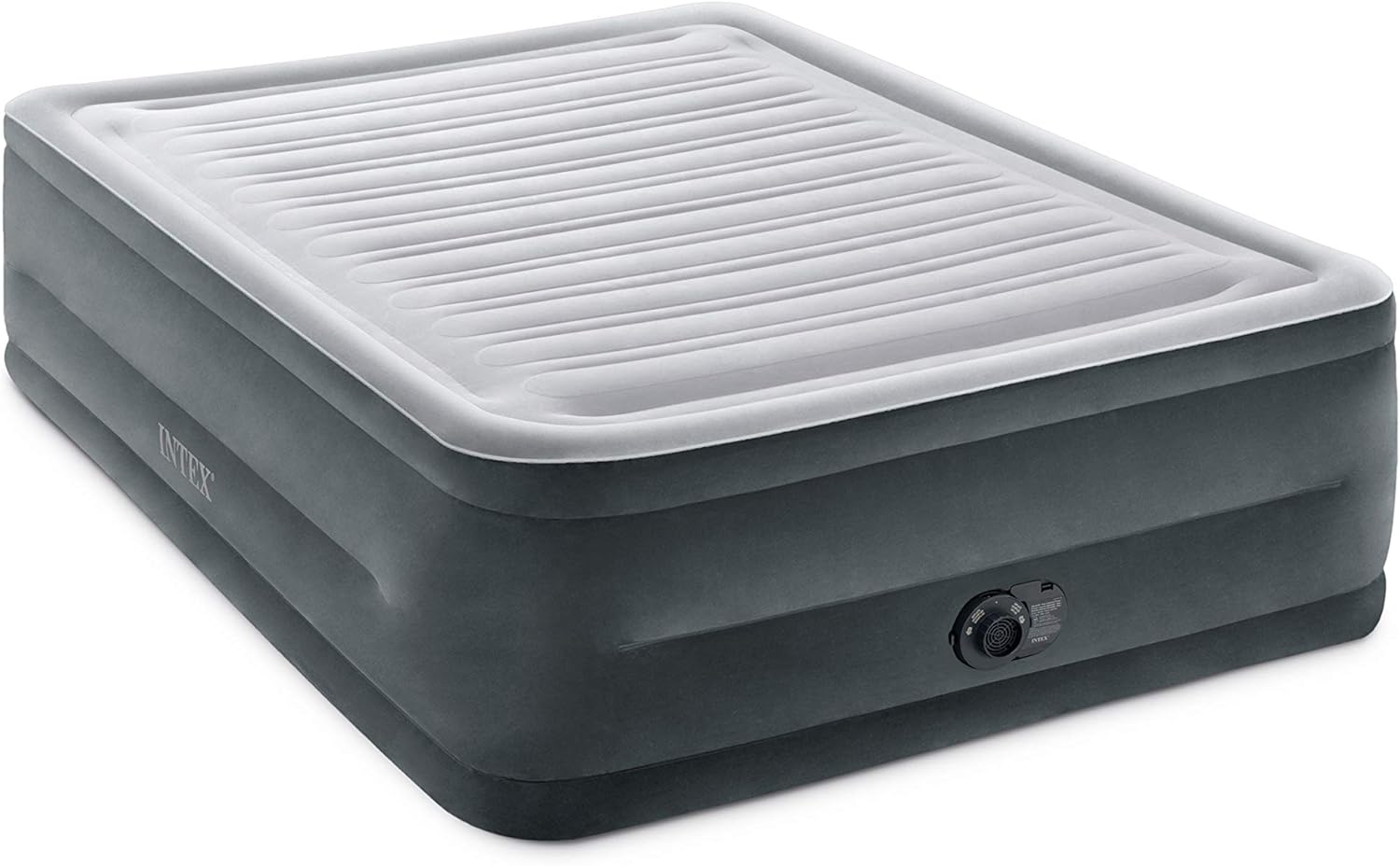
Intex Elevated Dura-Beam w/ Internal Electric Pump
Season
Car & cabin
Capacity
Twin / full (per size)
Setup
Inflate with built-in pump, top off manually if needed
Weight
See Amazon listing
Material
PVC with Dura-Beam interior
"Elevated sleep height, familiar bed height for older knees, and single-plug setup at the outlet."
The elevated airbed, especially one built around a Dura-Beam style internal construction and a built-in electric pump, is a piece of outdoor-adjacent gear that solves a problem the ultralight community can be reluctant to name out loud: getting off the ground matters. Knees, backs, and older hips that once shrugged at sleeping a finger’s width from pine needles can become vocal lobbyists in favor of height, and that is not weakness; that is body honesty. The Intex elevated Dura-Beam with internal electrics is aimed squarely at car-camp, guest-room, and overland bunks where a power point exists, where packed size is negotiable, and where “comfort per dollar” is a more relevant metric than “grams to summit.”
Dura-Beam, in contrast to the older endless-coil baffle look, is Intex’s attempt to add structural honesty to a PVC world that otherwise behaves like a water balloon. Internal fiber beams or interlinked support tubes reduce the “rolling into the middle” feel that used to be the punchline of airbed jokes. The elevated frame puts sleeping surface at something closer to domestic bed height, which is not trivial when you are stepping out into cold air or a tent porch full of sandaled feet. The internal pump, meanwhile, is the part that can create love or heartbreak, because a reliable inflation sequence—firm first night, top-up second night, gentle deflation without sounding like a jet engine—is a user experience, not a spec.
Our testing protocol is deliberately boring, because that is the point. We inflate on 120V first, time to full, note heat at the pump, and then listen for slow leaks in a quiet room overnight. We repeat on a mid-grade inverter in a vehicle to see whether thin wiring at the 12V socket sags the voltage; air pumps are amperage-sensitive in ways headlamps are not. We top up before sleep on the second night, because all PVC has some stretch cycle, and anyone who says otherwise is either lucky or not measuring. In tents, we watch wall contact—too wide a bed slams tub floors and invites condensation wicking where you do not want it, so we size the mattress to the shelter’s honest floor, not the shelter’s marketing name. “Fits three” in a dome rarely means “fits a queen and two humans in comfort” without touching fly.
The elevated frame carries trade-offs. It is a larger packed cylinder, heavier, and a larger puncture target than a low-profile mat. The honest failure modes are: sharp sticks under the floor, dog claws, and rivet heads on old cot frames, all of which we pre-check at sites because duct tape in the field is a skill, not a business model. A thick footprint or a cheap moving blanket is not a luxury, it is cheap insurance, especially on desert pavement where a tiny shard of mica is a knife.
In cold, air under you is, thermodynamically, a poor insulator. We add closed-cell foam, reflective film, or a good quilted blanket under a sheet so that the human side of the system does not try to heat an entire tent volume through one inch of air. In heat, the elevated bed is more breathable underneath than a floor-hugging pad in some conditions, but not magic; shade and a battery fan still outrank all mattress marketing.
Storing a built-in-pump model dry, folded loosely enough that creases do not kink, and with cord wrapped without sharp bends, extends the life of the product dramatically. The pump is an electromechanical wear item; if it fails, a separate pump and a valved top-off can be a workaround in the field, and we test that because Murphy loves camping at least as much as we do.
In life-cycle terms, the elevated Dura-Beam is not a thru-hike pad, not a two-person alpine bivy, and not an heirloom. It is a way to make family trips and road-life nights feel less punitive on the body, which often translates directly into more trips, longer seasons, and less reluctance the next time someone says “one more day by the water.” In that very practical sense, it is outdoor gear, even if it will never get you up a couloir. We respect it in that role and grade it for what it is: a reliable floor under the stories you actually tell in camp.
Final Verdict
"The civilized end of car-camp—still not a thru-hike pad, and that is fine."