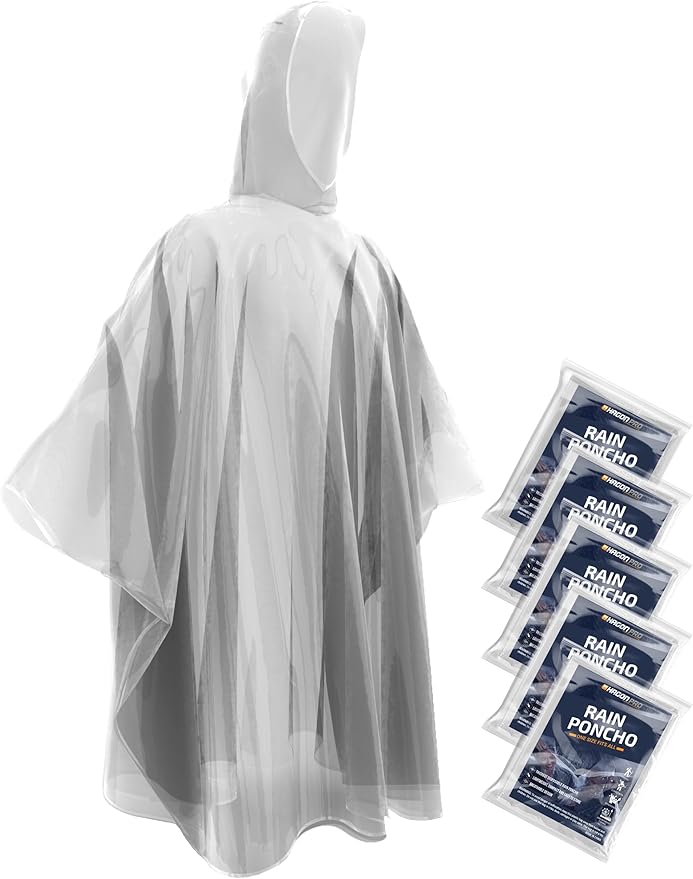
Hagon PRO Disposable Rain Ponchos (5-Pack)
Season
Any (single-use bias)
Capacity
1 user per piece
Setup
Unbag & wear
Weight
Trifling per poncho
Material
PE or PE-blend (per pack)
"Stash a five-pack: loan one to a partner, keep spares, stay moving when a squall appears."
Disposable rain ponchos sit in a strange emotional place in the gear world: we love to sneer at them in dry parking lots and quietly thank them when the sky opens three miles from the car. A five-pack like Hagon PRO is not pretending to be an Arc’teryx hardshell. It is insurance you can hand to a child, a friend, or a stranger, fold into a hip-belt pocket, and forget until the moment your weather app is proven a liar. Our testing of single-use and short-life ponchos is less about year-five durability and more about immediate coverage, range of motion over a pack, and the kind of field psychology that says “get moving before you get cold” instead of “repack your entire system in a downpour.”
In sustained rain, a poncho has one huge advantage: ventilation. A waterproof jacket that is truly waterproof for hours is, by physics, a sauna the moment the grade steepens. A well-cut poncho can vent heat and moisture in a way that a trapped microclimate under a hardshell will not, as long as you are willing to look a little like a public broadcast mascot. The trade, of course, is precision: sleeves flap, the hem catches wind, and brushy trails eat PE faster than a groomed boulevard. We set expectations accordingly: the poncho is a mobility piece for moderate terrain and social trails, not a bushwacking armor system.
The pack interaction is where we spend most of our time in evaluation. A poncho that barely clears your shoulders is useless the moment you wear a 45-liter pack. We look for gussets, extended length, and a hem that you can daisy to a hip belt in creative ways, because “billowing like a spinnaker” is fun on a catamaran, less so on a talus field. A poncho with a good cinch, snap, or even a waist cord—depending on the exact SKU—gains points because it can turn from cape to semi-tunic, which matters when you are trying to keep map corners dry without stopping the group for twenty minutes to deploy full rain kit.
In humid tropical-style rain, a poncho can outperform a “breathable” hardshell in comfort simply because the pit zips never quite win against the steam your body is generating. In cold, driven rain, the same poncho is a draft machine unless you add insulation layers in the right order: synthetic puffy, thin fleece, wicking baselayer, in that order of last resort to first touch on skin, depending on the temperature. The mistake we see most in novices is putting their best down mid-layer in the direct line of a poncho that does not protect shoulders—wet down is a trip-ender, not a style choice.
Sustainability is a fair critique of anything disposable, so we are explicit about the ethics. These packs are for targeted applications: one-off charity in a downpour, emergency backup, loaners on guided trips, and the kind of “we thought it was a chance of showers” forecast that is actually a six-hour soaker. We do not use them to replace a durable hardshell in places where a tear means exposure. We pack out torn plastic, we cut trash in half, and we prefer thicker PE over ultrathin “event rain sheets” that die on first contact with a zipper pull.
In group context, a five-pack is a social product. Distributing at the trailhead before a monsoon is how you make friends, not just because people stay dry, but because collective morale is sometimes the limiting nutrient on a bad day. A disposable poncho that lets someone with underpacked clothing stay warm enough to make good decisions is worth a dozen “correct” but unused ultralight purchases in a closet at home.
For individuals building a system, the rule is: carry one durable hardshell in your real forecast band, and stash a poncho in the car, the duffel, the festival belt bag, the boat dry box, or a kid’s school trip pack. If you are lucky, you will expire them from age, not from use. The first time a poncho keeps you from hypothermic shivers on a short hike out, the tiny weight and the tiny price feel enormous. Hagon and similar five-packs are not a philosophy; they are a field tactic. We respect them best when we treat the plastic with care and pack the moral courage to use them in service of the people we brought outside in the first place.
Final Verdict
"Pocket insurance—lighter than regret when the barometer lies."